
When humanoid robots waved red handkerchiefs on the stage of China’s Spring Festival Gala in early 2025, many viewers saw it as a novelty. Few realized it marked the beginning of a breakthrough year—one in which humanoid robots moved decisively from laboratories into real-world environments.
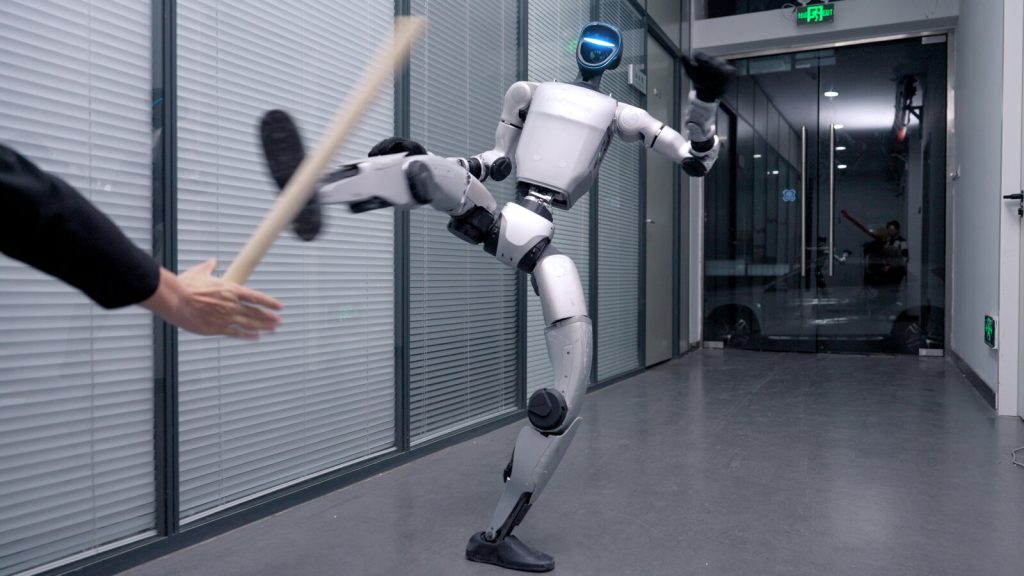
Throughout 2025, humanoid robots demonstrated rapid maturation. From Beijing’s innovation centers to global sporting events, machines such as the Tien Kung Ultra robot showcased unprecedented physical endurance by completing the world’s first humanoid robot half-marathon. Others, like Unitree’s G1, displayed advanced balance recovery, autonomous motion, and fluid human-like combat movements—clear signals that embodied intelligence is reaching a new level.
Yet hardware progress is only part of the story. Researchers increasingly agree that the true accelerator of humanoid robotics lies in large-scale AI models capable of directly transforming sensory input into physical action. China’s rapid advances in open-source AI have played a critical role here, enabling faster experimentation, collaboration, and deployment. In 2025, Chinese open-source models accounted for over 40% of global large-model releases, reinforcing the country’s growing influence in the global AI ecosystem.
This shift reflects a broader paradigm change. As leading scientists note, open source today is not just about sharing code—it is about reshaping how scientific knowledge is produced, distributed, and applied. AI is no longer merely a tool; it is becoming a driver of a new scientific and industrial revolution.
Looking ahead, the convergence of humanoid robotics, large AI models, and even space-based computing points toward a future where intelligent machines are embedded in homes, factories, hospitals, and research institutions. For universities and researchers, 2025 may be remembered as the year humanoid robots stopped being science fiction—and became a serious, tangible field of study shaping the next era of human–machine collaboration.