
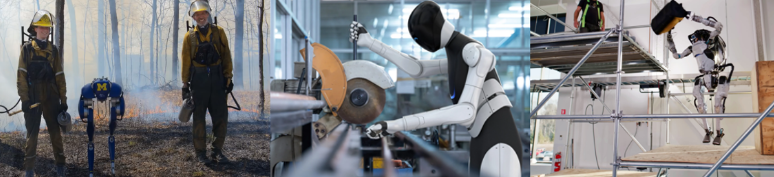
If you’ve been following the evolution of humanoid robotics, you’ll know we’ve moved from lab demos to real-world applications—and one of the most promising frontiers is construction. A recent paper lays out a compelling vision for how humanoids could transform the industry, along with a realistic roadmap to get there.
Why Construction Needs Humanoids
Construction is tough: labor shortages, dangerous conditions, and stagnant productivity are just some of the headaches. Humanoid robots, with their human-like form and movement, could step in to:
- Haul materials across uneven terrain
- Install fixtures, wire electrical systems, or tie rebar
- Inspect structures at height
- Handle hazardous tasks like demolition or asbestos removal
Unlike wheeled or tracked robots, humanoids can climb stairs, use existing tools, and navigate scaffolding—just like a human worker.
The Big Challenges
It’s not all smooth sailing and there are some major hurdles:
- Perception: Sites are dusty, cluttered, and constantly changing. Robots need “long and deep perception” to anticipate changes and sense through debris.
- Locomotion: Walking on mud, gravel, or partially built floors requires next-level balance and adaptability.
- Dexterity: We’re talking about tasks like threading pipes or tightening bolts—things that require fine motor skills and tactile feedback.
- Power & Payload: Battery life is short, and lifting capacity is still limited.
- Human-Robot Teaming: How do we ensure safety and smooth collaboration on a busy site?
A 10-Year Roadmap
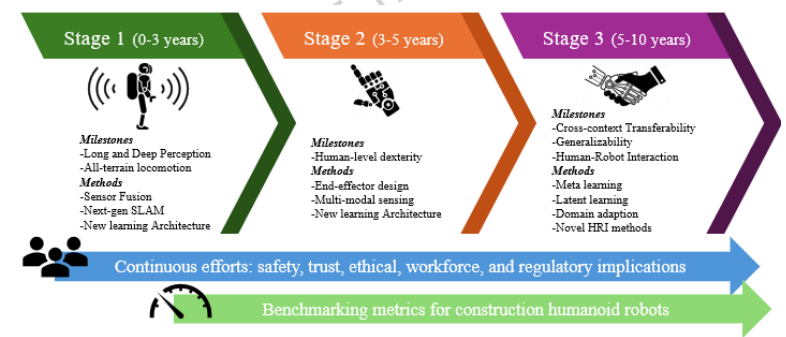
- Stage 1 (0–3 years): Focus on perception and locomotion in realistic mock-up sites.
- Stage 2 (3–5 years): Advance manipulation skills, tool interfaces, and data-driven learning.
- Stage 3 (5–10 years): Achieve generalizability across sites and deeper human-robot interaction.
Continuous efforts in safety, ethics, and workforce training are emphasized throughout.
Beyond the Tech
It’s not just about better algorithms or stronger actuators. We also need to think about:
- Workforce retraining and new job roles
- Regulatory frameworks and liability
- Public perception and trust
- Economic models to make adoption feasible
Join the Conversation
This is a call to action for roboticists, AI researchers, construction professionals, and policymakers. Whether you’re working on SLAM, reinforcement learning, gripper design, or safety standards—your expertise is needed.
Let’s build the future, one robot at a time.