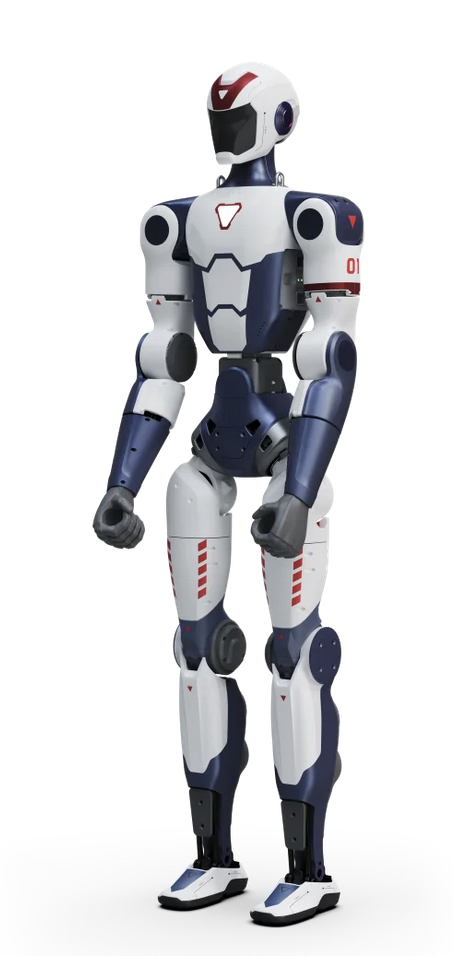
Unitree R1

The Unitree R1 is a compact, modular humanoid robot designed for education, research, and AI development, available in multiple programmable configurations.

Price on request

Unitree R1 Humanoid Robot

Unitree R1 is a compact, modular humanoid robot designed for education, research, and AI development.
With multiple versions—from a base model to advanced EDU configurations with dexterous hands—R1 scales from interactive demos to
full development workflows including simulation (e.g., Isaac Sim) and high/low-level programming (variant-dependent).

Dimensions (standing)1210 × 357 × 190 mm
Weight~25 kg
DoF24–40 (variant-dependent)
Battery life~1 hour (per battery)



Highlights

  • Modular lineup: base model plus multiple EDU variants (U1–U6).
  • Up to 40 DoF: more natural, precise motion (depending on configuration).
  • AI-ready compute: listed up to 100 TOPS (variant-dependent).
  • Perception: stereo camera for environment capture.
  • Fast deployment: lightweight (~25 kg) with a quick-swap Li-ion battery (~1 hour runtime).
  • OTA updates: supported.

Technical Hardware Specifications

Core technical data (R1 family)

Dimensions (standing) 1210 × 357 × 190 mm
Weight Approx. 25 kg
Degrees of freedom (DoF) 24–40 (depending on model)
Max arm payload 2 kg
Leg length 0.675 m
Arm span Approx. 0.435 m
Connectivity Wi-Fi 6, Bluetooth 5.2
Power Lithium battery, quick swap
Operating time Approx. 1 hour
OTA updates Supported

Note: compute capability and programmability depend on the selected model (see overview below).

Model Overview – Choose Your Version

Model Key differences DoF Hands Development
R1 Base Entry model with stereo camera and 8-core CPU (listed); focused on demos 24 Not programmable (as listed)
R1 EDU U1 Added AI compute (+40 TOPS listed) and dev workflow support Model-dependent High + low-level programming; simulation support (e.g., Isaac Sim)
R1 EDU U2 Adds head DoF (+2 DoF listed) and higher AI compute (100 TOPS listed) 26 Programmable
R1 EDU U3 Two Dex3-1 three-finger hands (no tactile, listed) 40 2× 3-finger (no tactile) Programmable
R1 EDU U4 Like U3, but with tactile sensing in the hands (listed) 40 2× 3-finger (tactile) Programmable
R1 EDU U5 Two Revo 2 Basic five-finger hands (listed) 38 2× 5-finger (basic) Programmable
R1 EDU U6 Like U5, but Revo 2 Touch hands with tactile sensing (listed) 38 2× 5-finger (tactile) Programmable

If you want SDK access and algorithm development, choose an EDU variant (U1–U6). The Base version is listed as non-programmable.

Typical Applications

  • University courses and robotics education
  • Embodied AI and imitation learning research
  • Simulation-to-real (Sim2Real) pipelines
  • Interactive demos and technology events
  • Dexterous manipulation experiments (U3–U6)

Scope of Delivery (typical)

  • 1× Unitree R1 (selected version)
  • 1× battery
  • 1× controller
  • 1× charger

FAQ

Which R1 version is best for software development?

Choose an R1 EDU model (U1–U6). The Base version is listed as not programmable.

How do I choose between U3/U4 and U5/U6?

U3/U4 focus on three-finger hands; U5/U6 focus on five-finger hands. The “4” and “6” variants add tactile sensing.


Seller Logo

Seller Short Description

QUADRUPED Robotics GmbH is a German robotics company specializing in the development, distribution, and support of advanced four-legged robotic systems. The company’s product line features modular quadruped robots built on the Robot Operating System (ROS), enabling flexible programming and adaptation to diverse environments and use cases. Its offerings include high-performance models such as the Quadruped A1, Aliengo, B1, and Go1, distinguished by stable locomotion, real-time HD video capabilities, and intelligent sensing features. QUADRUPED Robotics GmbH partners with industry experts and research institutions to push the boundaries of mobile robotics and deliver solutions for research, industrial, and commercial applications.

Seller Description

QUADRUPED Robotics GmbH is a German company specializing in advanced quadruped robotic systems. It provides modular, ROS-based four-legged robots designed for research, industrial, and commercial applications, combining robust locomotion, intelligent sensing, and flexible integration.

Specifications